Showing posts with label health care. Show all posts

Thursday, September 20, 2012

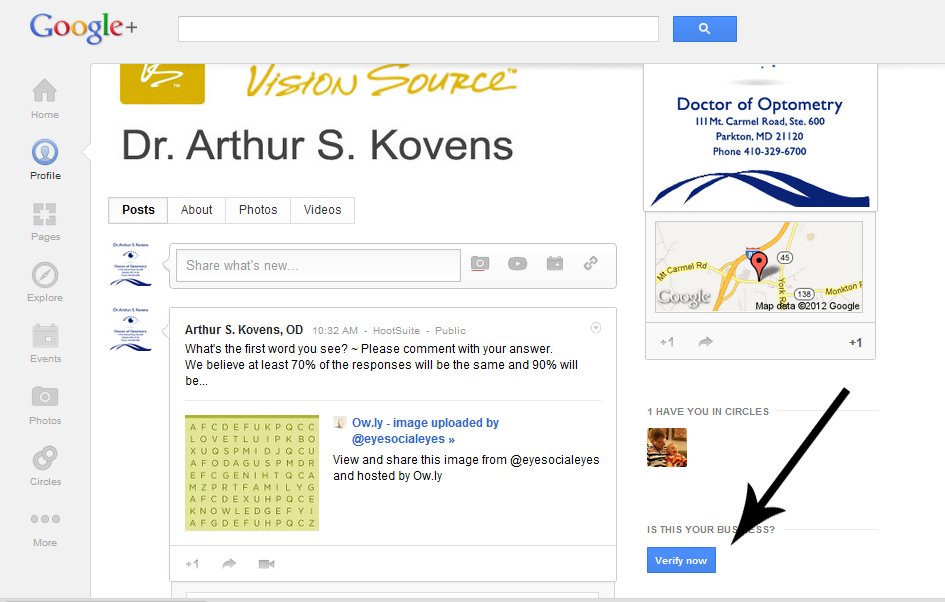
Steps to verify your Google+ Page.


Have you verified your Google+ Page yet? By verifying your Google+ Page it allows you to connect it to your Google+ Local Page. As you can see here http://bit.ly/VeoBh7 my Google+ Local listing (The one where people write reviews) is now connected to my Google+ Page (Think of it as Facebook for Google). You can see my posts and review me as well.

Go to your Google+ Page and follow the easy steps below!
 
1. Click "Verify".


2. Choose your Google+ Local listing and Click "Yes Let's Continue"


3. Click "Yes Let's Continue".


4. Click "OK" They will send a postcard with a Pin Number to your Office.


5. Once you receive the Pin Number go to your Google+ Page, click "Enter Pin" and Enter your Pin.


6. Voila! You are now Verified!

Tuesday, December 6, 2011

Getting over the Facebook hump! - Social Media Marketing - Optomerty, Vision Care, Eye Care

It's a great feeling when that facebook page you have been working on so hard on suddenly takes on a life of it's own. You've worked so hard setting up the apps, uploading the perfect pics, recruiting fans and blasting out posts and now people are starting to interact. Interaction is the key to a successful facebook page. Without it no one else reads your perfectly worded posts, no one sees your pretty pictures and worst of all no one shares your page with anyone else.

So how does one create a page that encourages social interaction? You can do it yourself if you have the time or you could hire a professional like SocialEyes. SocialEyes has been working with Eye Care Professionals for over 20 years now and they know how to create Social Media Gold! The Eye Care industry is a tough place to market yourself in but SocialEyes invented Social Media Marketing for the Vision Care Community!

We create an environment for your patients to interact in. Our Doctors now have hundreds of fans asking to buy contacts, find them special eye glass frames, leave them excellent reviews and comment on our interesting posts. These interactions create fans and these fans translate into happy patients who generate revenue.

Please stay tuned for more on getting over the facebook hump. It is late and I need my beauty rest :)

Thursday, November 24, 2011

What’s Next in Social Media Marketing? - It is time for Eye Care Professionals to ride the Bandwagon.

Here are the top 10 insights:

1) The physical and digital worlds will be more highly connected than ever before – already today we are able to run in the park and track our progress online while sharing it with our friends or track our weight loss, or even our ovulation (well, some of us, that is) with iPhone apps that connect to our Facebook and twitter profiles and enable us to keep track of our progress as well as share the data with our friends. Robert Scoble had a brilliant presentation on this topic at the last TNW Conference in Amsterdam. You can see it here.

2) Facebook, Twitter and other major social networks will become increasingly what Fred Wilson coins “Social Dashboards”. In essence, Facebook and Twitter are social channels on which other companies can grow and develop their own technologies and businesses. Both Facebook and Twitter have created economies far larger than many nations. Take for example, companies like Stocktwits, Tweetdeck and Zynga, (amongst others) that have gained huge profits “piggybacking” on these two platforms.

3) Until now, brands have been very concerned with bringing as many people as possible to their pages. Consumer brands can now finally reap the fruits and build social commerce stores where Facebook users (all 700 Million of them) can purchase products on their favorite social network without needing to go to any destination site. Facebook will become one of the major channels of future online shopping.

4) Companies like Google, Facebook and Amazon are currently collecting information about each any every one of us: Our likes and dislikes, our interests and disdains. Soon in an age of Web 3.0, an age of Semantic Web, we will no longer need to search for information on the Web as information will find us based on all this data which companies are collecting. The right information will be served to the right people at the right time, saving us all a lot of time, effort and energy.

5) Mobile technology will become more dominant and NFC technology will be developed further enabling it to offer us special promotions, coupons and tips based on our geographical location and the interest graph we discussed in insight #3.

6) Human Relationships will no longer be as physically dependent and we will befriend and hang out with people from all over the world and all walks of life, all ethnicities and all beliefs, creating a worldwide melting pot.

7) We will no longer be passive media consumers. Media will interact with us in dynamic ways on all platforms. Just like gamers playing WOW today, we will all become a part of a virtual world unknown to us yet where we will all be avatars in the game of life.

8 ) As the Web is overloaded with more information, the content that we are exposed to will become more and more customized to our needs as companies will large sums of money to companies like Facebook and Google, making sure that the information we are exposed to is highly targeted to our interests. Rather than experiencing information overload, we will actually experience the opposite effect.

9) Companies will understand better how to measure the ROI of social media and realize that social media is not about the number of people brands have in their communities but rather the amount of engagement that they see on their page and the overall online sentiment they faced this month as opposed to the last. See Gary Vaynerchuk’s response to how companies should measure the ROI of social media in the video link above.

10) Services will become increasingly crowdsourced. Whether it be the way that we get from point A to point B (Waze), the way that we find answers to our questions (Quora), the manner in which we test our Websites (uTest), the way that we get things done (Fiverr) or the way that we share information (Wikipedia).
All of these insights are of course complete speculations based on my years of experience in the world of social media and following of trends occurring all over the digital space. Do you agree with these speculations? Is anything missing? What do you think is coming up next in social media?

Ayelet Noff is the founder and CEO of Blonde 2.0 , a New Media PR agency helping brands create brand awareness and increase social engagement. Check out Ayelet's Blonde 2.0 blog and Twitter.

Tuesday, November 15, 2011

Why is Blogging so important to Search Engine Optimization? Social Media Optometry

How many times have you heard someone say, I just want that top search result on Google? For a business website, the top spot in the search engine returns can be a lead generating machine.

Think about it. Google is where most people go when they are researching. What if there was a way to get your company’s website on that coveted first page? Well there is…

One of the best ways to gain that top spot is by blogging. Incorporating a blog into a website can have a huge impact on the overall website’s search engine rankings.

A blog does two important things in terms of the search engines:

Adds naturally occurring, keyword-rich pages.
Increases the potential for incoming links from high-quality websites.
This article will reveal the why and how for improving your search engine rankings with blogs.

Playing the Numbers—Static vs. Dynamic Websites
The average small business website includes anywhere from 10-20 static web pages. These are the basic pages you see on most sites such as the home page, an “about us” page, product descriptions and even pages with contact information. Once created, these pages rarely change. In some cases, even small changes on these pages can be an expensive proposition that involves bringing in a web designer.

If the site is well-built with all the appropriate code and metadata, the search engines will index these 10-20 pages of content. If the site is highly optimized and focused on a limited number of keywords, the search engines may connect those 10-20 pages with the right keywords (the search engine terms used to find information). However, due to the inherent needs of a website, some pages aren’t indexed for the desired keywords (i.e., contact forms).

Best-case scenario, 10-20 pages are recognized by the search engines as possible returns for the targeted keywords.

The Impact of Blog Posts
Now let’s take our static website and add a blog. For the sake of this example, let’s say that there are five representatives in the company who have each agreed to write one blog post per week.

Here’s where our blog really starts to pay off. Each time a new blog post is added, a new page is indexed by the search engines. By the end of the first month, the website has doubled the number of pages originally indexed by the search engines.

Within a month, our website—which originally had 10-20 pages in the search engine pool—now has 30-40 pages that can possibly be returned in the top spot on Google. Stretch that out over the course of a year and our 10-20 page website now has around 250 pages indexed in the search engines.

And while a blog post a day is a lot of work, scale it back to one blog post per week and we’ve still more than doubled the number of indexed pages during the first year.

Each indexed page adds another ticket to the great Google lottery. The more tickets you hold, the better chance of winning the top spot in the search engine rankings.

The Power of Incoming Links
Now let’s say that our faithful bloggers have been adding their daily posts on topics of interest to their industry. Word gets around that they put up some valuable information and at the very least offer a voice for the company. A couple of blog posts have been emailed to fellow colleagues and even better, fellow industry bloggers are starting to link to the blog. The site starts to appear on fellow bloggers’ blog rolls and specific posts are linked as references and points of discussion in other online publications.

Google likes these incoming links. Google likes them even more when the links come from sites that are relevant to the content in the blog.

Then one day, a mild-mannered New York Times reporter is conducting research for a story related to our company’s industry. Because the blog has added a number of indexed pages to the website and others have started to link to the blog, it pops up in the reporter’s Google search. Our reporter includes a link to the blog in his article.

Google really likes incoming links from big, high-traffic sites like the New York Times. Along with the initial traffic sent to the blog from the New York Times article, Google sees that the New York Times linked to our site in an article related to keywords indexed in our blog. Google recognizes that the New York Times is an important Internet site and makes the connection that because the New York Times has linked to our little blog, our blog must be important. Thus Google moves it up the search engine rankings.

Congratulations. Thanks to the addition of a blog, our little website of 10-20 static pages now holds one of the top spots in Google search results.

Indexed Pages + Relevant and Reputable Links = Search Engine Success
At the 2009 WordCamp San Francisco (a gathering of WordPress users), Google’s Matt Cutts pointed out the importance of being both relevant and reputable. Incoming links from reputable sites such as the New York Times in which the content is relevant to the content in the post are highly valued by Google.

A blog is one of the best ways to continually add pages to a website that generate relevant and reputable links.

In the scenario above, our business blog has managed to provide both relevant content and generate reputable links—two big keys to success on Google.

Real-World Example
Don’t believe me? Let’s take a look at a real-world Google search to see the impact of a blog in action.

Let’s say that we’ve just moved to Baltimore and need a realtor to help us find a new home. We go to Google and search “Realtor Baltimore.” Once we get past the map-based search results (important to note), the national sites such as Realtor.com and the national brokerages, one of the first local real estate agents to show up in the organic search results is Wayne Curtis at www.charmcityrealestate.com.

CharmCityRealEstate.com includes a blog with posts dating back to November 2006. As you can see in the image below, Google has indexed 145 pages of CharmCityRealEstate.com. Many of these pages are blog posts filled with naturally occurring keywords related to the real estate market in Baltimore.


Now let’s take a look at another realtor in the Baltimore area. This realtor’s website did not rank in the Google search results and does not include a blog. As you can see from the image below, the site shows only 14 pages indexed with Google.


Measuring incoming links is a little more difficult as different tools return different numbers. You can get a basic overview by using the search term “link:yourdomain.com” in both Google and Yahoo. Using Alexa.com’s “Site Info” tool we can see www.charmcityrealestate.com’s top incoming links. The very first link returned on Alexa is a link from HDTV.com’s television series House Hunters, a highly relevant and reputable real estate site.


Quality of Pages Indexed and Incoming Links
When conducting this experiment, you can find sites that don’t rank as well on Google yet have more pages indexed. This is often because the pages indexed do not rank for the keywords searched. A topical blog naturally lends itself to keyword-rich posts just by the nature of the content.

The same holds true with incoming links. Too many incoming links from websites that are not relevant to the content on the site can actually hurt a website’s search engine ranking.

Consider Keywords When Creating Posts
Now that you can see the importance of keyword-indexed blog posts, you can begin to optimize your posts to include relevant keywords.

Going back to our example above, we can use the Google Keyword Tool to see that during the month of March, the phrase “Realtor Baltimore” was searched on Google 2,900 times in the U.S.; however, the phrase “Realtors Baltimore” was searched 60,500.


Since “Realtors Baltimore” was searched around 57,000 more times than “Realtor Baltimore,” it would be wise to use both terms when writing a post about choosing a realtor in Baltimore.

Incorporate the Blog
If the goal is to raise the search engine results of the larger website, it is important to incorporate the blog into the larger website. Use a call to action at the end of the blog post to direct the reader to other parts of your website. Keep it on the same domain and provide clear links that encourage visitors to explore the rest of your website.

Make it easy for your reader. If the path to your larger website isn’t clearly marked, they will never find their way.

ROI
Measuring the ROI of social media is tricky, but consider the value of the top spot on Google. How much would you pay for the top organic search return? Although it doesn’t happen overnight, a blog can be one of the best ways to get there.

Have you seen a jump in the search engine rankings since adding a blog? If your business is not blogging, what’s holding you back?

By Jim Lodico
Published May 24, 2010

Wednesday, May 4, 2011

Social Media benefits for Eye Care professionals. Your patients vision.

Our communities have been redefined over the decades. Cavemen gathering around their first fire, Pilgrims settling the first colonies, 50's soda pop shops, 90's internet cafe's and now Social Media Communities. That's right we rarely even pick up the phone anymore. I was out today visiting a prospective client. I asked her are you on facebook. She replied. How do you think I stay in touch with my mother? 

The question you must ask yourself is are you socially connected and if not why aren't you? . For instance, Facebook estimates it has more than 500 million active users. Adults "friend" their kids, parents, coworkers, poker buddies and friends from high school, among others. They become "fans" of businesses, clubs and grassroots initiatives. No longer a mystery, social media sites are the places to be.
The average age of a social networker is 37 years old,  for a suburban family practice, this is your target patient age range.
Those optometrists who have begun to use social media sites, such as Facebook and Twitter, are finding that social media is not just a fun add-on to the marketing strategy. It really can produce results.

Social media is a new way of looking at marketing. It requires a kind of day-to-day authenticity that differs from more traditional forms of marketing, where customers do not post opinions of your business — both good and bad — in real time.

The one question I always hear is, well where and how do I start? Social Media Marketing can often seem overwhelming and it may be a good idea to let a professional help you. SocialEyes LLC is a great place to get started. They are professional, effective and affordable.


No matter what route you take to becoming socially connected just make sure you start the journey.


Thanks


Michael Muller
mike@eyesocialeyes.com

Recent Posts