Showing posts with label face book optometry. Show all posts

Thursday, September 20, 2012

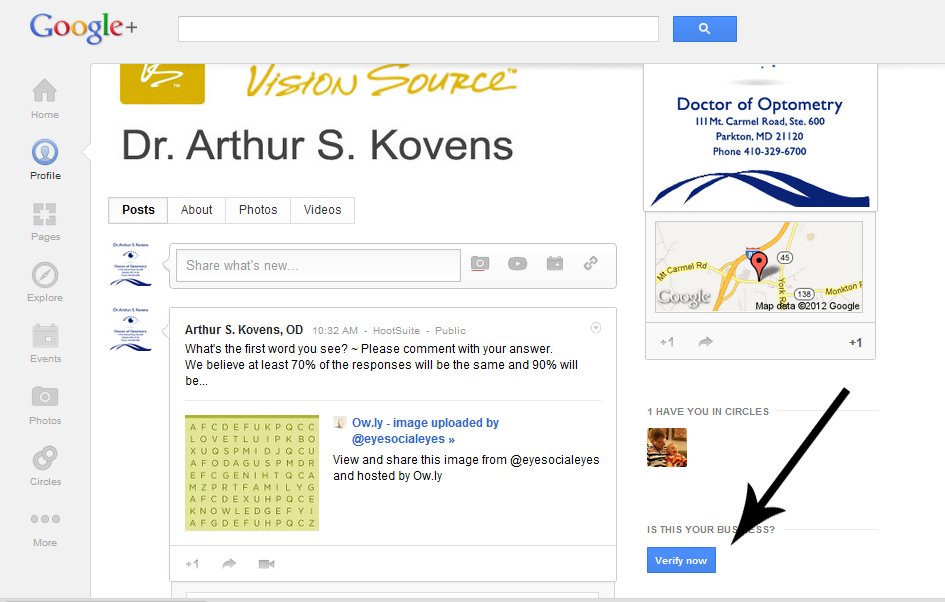
Steps to verify your Google+ Page.


Have you verified your Google+ Page yet? By verifying your Google+ Page it allows you to connect it to your Google+ Local Page. As you can see here http://bit.ly/VeoBh7 my Google+ Local listing (The one where people write reviews) is now connected to my Google+ Page (Think of it as Facebook for Google). You can see my posts and review me as well.

Go to your Google+ Page and follow the easy steps below!
 
1. Click "Verify".


2. Choose your Google+ Local listing and Click "Yes Let's Continue"


3. Click "Yes Let's Continue".


4. Click "OK" They will send a postcard with a Pin Number to your Office.


5. Once you receive the Pin Number go to your Google+ Page, click "Enter Pin" and Enter your Pin.


6. Voila! You are now Verified!

Wednesday, December 14, 2011

Social Media tips fo the Eye Care Professional, Internet Marketing for the Vision Care Community.


It’s a fair bet that your boss, dates and anyone you give your business card to will type your name into a search engine. If something negative appears in the results, your online reputation can quickly damage your offline reputation — and affect your life.
Of the almost 80% of U.S. hiring managers who had searched for candidates online, 70% of them said they had rejected a candidate based on what they found in his or her search results, according to a 2009 study commissioned by Microsoft.
While you might not be able to remove damaging content from the Internet, there’s a good chance that you can minimize its impact using simple SEO techniques. And even if your search results are squeaky clean, the same techniques can help you control how you’re perceived online.
Here’s how to get started.

Step 1: See Where You Stand


Before you can manage your online reputation, you have to assess it. Type your names in search engines. Set up search alerts for your name (Google recently made this easier to do from the Google dashboard through a new “Me on the Web” tool).
If you find something unflattering, ask yourself:
  • Did I post it? If, for instance, photos from your Flickr account that you’d rather keep private are showing up in search results for your name, you can simply delete the photos or adjust your privacy settings.
    After you’ve removed the offensive content, you can use Google’s URL removal tool to stop it from appearing as a cached copy or snippet in search results. If you do nothing, the content will still eventually drop from Google’s index — it will just take a bit longer to disappear.
  • Is it personal information that could be used in a crime? If someone posts your social security number, bank account number, credit card number or an image of your handwritten signature, Google will makeefforts to remove it from search results. It will also contact the site’s hosting company to request that the page be taken down.
  • Is it posted on a high-traffic news site? Competing for search results with a popular news site is difficult. ButPatrick Ambron, the cofounder of a personal online reputation management service called Brand-Yourself, says that all hope is not lost. “Google usually only likes to rank one result per domain name per page,” he says. “So if you could get another result on the same domain name like Huffington Post that was better optimized for your name, you could theoretically knock the bad article off.” One way to do this is to create a profile on that news site using your full name. Use as many links as possible, and link to the profile from all of your other web properties.
If you can’t answer “yes” to either of these questions, your best bet for reducing the visibility of negative content is to compete for top search results using positive content.


If you can’t get the content removed from the original site, you probably won’t be able to completely remove it from Google’s search results, either,” reads Google’s guide to keeping personal information out of Google. “Instead, you can try to reduce its visibility in the search results by proactively publishing useful, positive information about yourself or your business.”
In other words, if you want to make negative webpages appear lower in search, you’ll need to create content of relevance to push the negative links down. Google suggests responding to negative reviews of your business, for instance.
Profiles on social networks are powerful tools for this purpose, as results from large sites like Facebook andTwitter often carry more SEO power than a single post on something like a personal blog.


Step 2: Post Positive Content


“If you can’t get the content removed from the original site, you probably won’t be able to completely remove it from Google’s search results, either,” reads Google’s guide to keeping personal information out of Google. “Instead, you can try to reduce its visibility in the search results by proactively publishing useful, positive information about yourself or your business.”
In other words, if you want to make negative webpages appear lower in search, you’ll need to create content of relevance to push the negative links down. Google suggests responding to negative reviews of your business, for instance.
Profiles on social networks are powerful tools for this purpose, as results from large sites like Facebook andTwitter often carry more SEO power than a single post on something like a personal blog.

Step 3. Create an Identity Hub

One secret to pushing your positive online presence further up in search results is to make a hub that links to all of your content. Ambron recommends these tips for pushing your hub to the top of search results for your name.
  • Claim your domain name. Including the search term (in this case, your name) in the URL of your web page tells search engines what the page is about.
  • Mention yourself. You’re trying to tell search spiders, “This page is about me!” A good way to do that is to use your name a lot. Use your name in tabs and headers.
  • Link to your content. “[Google] considers each link to your site a vote for the site,” Ambron says. “Google has gotten pretty smart, so where those links come from is very important. The more reputable links are better votes. A vote from CNN is better than some site you made that you just linked to yourself.”
    Remember all of those social media profiles that you created in step two? They’re attached to reputable sources like Facebook and Twitter, which makes their “votes” count as much more reputable than a page you just created.
    Sign up for as many of them as possible (use one of these sites to see what is available), and then link them all to your hub.
  • Post often. Search engines like fresh content. One easy way to create it is to post your social media feeds to your blog.
  • Step 4. Consider Automating the Process


    There are several services that will help you with your quest for a pristine online reputation for a small fee.Brand-Yourself, for instance, keeps track of your reputation on a dashboard and helps you improve it by helping you raise existing positive content or helping you create new positive content. Vizibility allows users to pre-select the information they want displayed in “search results” from a special button or URL that can be added to online profiles, websites, resumes, email signatures and business cards.

    This article was reposted form Mashable. http://mashable.com/2011/06/27/manage-online-reputation-seo/


      Series Supported by SES San Francisco Conference & Expo

      The Future of Search Series is supported by SES San Francisco Conference & Expo. Join more than 6,000 marketers August 15-19 at the Moscone Center for five days of education, inspiration and conversations with the most important voices online. Learn about the industry’s most pressing developments — everything from Google Panda to YouTube LIVE — and every essential topic, including email, display, mobile, search, social media, video and more. Register with “MASH20″ to save 20%. Join the discussion: #SESSF.

Thursday, November 24, 2011

What’s Next in Social Media Marketing? - It is time for Eye Care Professionals to ride the Bandwagon.

Here are the top 10 insights:

1) The physical and digital worlds will be more highly connected than ever before – already today we are able to run in the park and track our progress online while sharing it with our friends or track our weight loss, or even our ovulation (well, some of us, that is) with iPhone apps that connect to our Facebook and twitter profiles and enable us to keep track of our progress as well as share the data with our friends. Robert Scoble had a brilliant presentation on this topic at the last TNW Conference in Amsterdam. You can see it here.

2) Facebook, Twitter and other major social networks will become increasingly what Fred Wilson coins “Social Dashboards”. In essence, Facebook and Twitter are social channels on which other companies can grow and develop their own technologies and businesses. Both Facebook and Twitter have created economies far larger than many nations. Take for example, companies like Stocktwits, Tweetdeck and Zynga, (amongst others) that have gained huge profits “piggybacking” on these two platforms.

3) Until now, brands have been very concerned with bringing as many people as possible to their pages. Consumer brands can now finally reap the fruits and build social commerce stores where Facebook users (all 700 Million of them) can purchase products on their favorite social network without needing to go to any destination site. Facebook will become one of the major channels of future online shopping.

4) Companies like Google, Facebook and Amazon are currently collecting information about each any every one of us: Our likes and dislikes, our interests and disdains. Soon in an age of Web 3.0, an age of Semantic Web, we will no longer need to search for information on the Web as information will find us based on all this data which companies are collecting. The right information will be served to the right people at the right time, saving us all a lot of time, effort and energy.

5) Mobile technology will become more dominant and NFC technology will be developed further enabling it to offer us special promotions, coupons and tips based on our geographical location and the interest graph we discussed in insight #3.

6) Human Relationships will no longer be as physically dependent and we will befriend and hang out with people from all over the world and all walks of life, all ethnicities and all beliefs, creating a worldwide melting pot.

7) We will no longer be passive media consumers. Media will interact with us in dynamic ways on all platforms. Just like gamers playing WOW today, we will all become a part of a virtual world unknown to us yet where we will all be avatars in the game of life.

8 ) As the Web is overloaded with more information, the content that we are exposed to will become more and more customized to our needs as companies will large sums of money to companies like Facebook and Google, making sure that the information we are exposed to is highly targeted to our interests. Rather than experiencing information overload, we will actually experience the opposite effect.

9) Companies will understand better how to measure the ROI of social media and realize that social media is not about the number of people brands have in their communities but rather the amount of engagement that they see on their page and the overall online sentiment they faced this month as opposed to the last. See Gary Vaynerchuk’s response to how companies should measure the ROI of social media in the video link above.

10) Services will become increasingly crowdsourced. Whether it be the way that we get from point A to point B (Waze), the way that we find answers to our questions (Quora), the manner in which we test our Websites (uTest), the way that we get things done (Fiverr) or the way that we share information (Wikipedia).
All of these insights are of course complete speculations based on my years of experience in the world of social media and following of trends occurring all over the digital space. Do you agree with these speculations? Is anything missing? What do you think is coming up next in social media?

Ayelet Noff is the founder and CEO of Blonde 2.0 , a New Media PR agency helping brands create brand awareness and increase social engagement. Check out Ayelet's Blonde 2.0 blog and Twitter.

Saturday, October 15, 2011

facebook "Likes" power search engine results!

I was trying to convince someone today that websites are soon to be a thing of the past. Why do you ask would I ever say something as absurd as this? Well, because they are. Facebook is the new"King of all Media", move over Howard Stern! Here is a quote from an article I read;

"The news broke yesterday that Facebook was getting a whopping $500 million from Goldman Sachs and existing investor Digital Sky Technologies at a valuation of $50 billion."
It goes on to say;

"Imagine that Facebook were to become convinced that having its own search engine was a key to delivering a better user experience overall, as well as generating new ad revenue. One obvious and immediate possibility would be to buy Blekko, which has pushed social integration with Facebook Likes further than Microsoft itself."

Let's face it, on facebook, all of our social relationships reside there, we express ourselves and share there, we check in, we find deals, we are marketed to and most importantly we are on it every day! If you search even generic terms in the facebook search bar a "bing" search pops up. Why would we ever leave facebook? The answer is soon we will not. That is why webpages are a thing of the past.I can learn every thing I want about a business right from their facebook page.

This my friends is why facebook likes are so important. They are powering search engine reults, especially "Bing" ! Check this article out. Facebook Likes and Search Engine

Well I have to go and pick up my son from school. See you on the Blog side!

Monday, September 26, 2011

facebook "Likes" power search engine results!

I was trying to convince someone today that websites are soon to be a thing of the past. Why do you ask would I ever say something as absurd as this? Well, because they are. Facebook is the new"King of all Media", move over Howard Stern! Here is a quote from an article I read;

"The news broke yesterday that Facebook was getting a whopping $500 million from Goldman Sachs and existing investor Digital Sky Technologies at a valuation of $50 billion."
It goes on to say;

"Imagine that Facebook were to become convinced that having its own search engine was a key to delivering a better user experience overall, as well as generating new ad revenue. One obvious and immediate possibility would be to buy Blekko, which has pushed social integration with Facebook Likes further than Microsoft itself."

Let's face it, on facebook, all of our social relationships reside there, we express ourselves and share there, we check in, we find deals, we are marketed to and most importantly we are on it every day! If you search even generic terms in the facebook search bar a "bing" search pops up. Why would we ever leave facebook? The answer is soon we will not. That is why webpages are a thing of the past.I can learn every thing I want about a business right from their facebook page.

This my friends is why facebook likes are so important. They are powering search engine reults, especially "Bing" ! Check this article out. Facebook Likes and Search Engine

Well I have to go and pick up my son from school. See you on the Blog side!

Recent Posts