Showing posts with label eye care. Show all posts

Monday, October 8, 2012

Link your Website to your Google+ Page.

It's Google+ time again and SocialEyes has another important tip in furthering your successful internet marketing campaign.  

Today we are going to discuss linking your website to your Google+ Page! This is extremely important as this function will make your Google+ page eligible to show up on the right hand side of the Google search page for relevant search queries and make your Google+ page more discoverable.

By adding a short line of code to your website's html you can verify and link your website to your Google+ business page (This is not your personal profile but your page under your personal profile).

Do it yourself or ask your site's webmaster to add the line of code provided by Google to your website's homepage.
After you are finished it will take a few days to start showing up but once it does; BAM your page becomes much more visible!
Follow the simple below:
1. Go to your Google+ page, click on the about tab, scroll down and click the "link website" button. (Make sure your profile contains your website first. If not click edit profile and add your website.)


2. Copy the code provided in the box. 


3. Take the code and either add it yourself or ask your site's webmaster to add the line of code provided in the box to your website's homepage.


4. Once the code is added to your website click the "test website" button.


5. If done properly you should get the "Test Successful" message. Click done and hold on tight while your practice jumps to the top of the search results!

Thank you!

Thursday, September 20, 2012

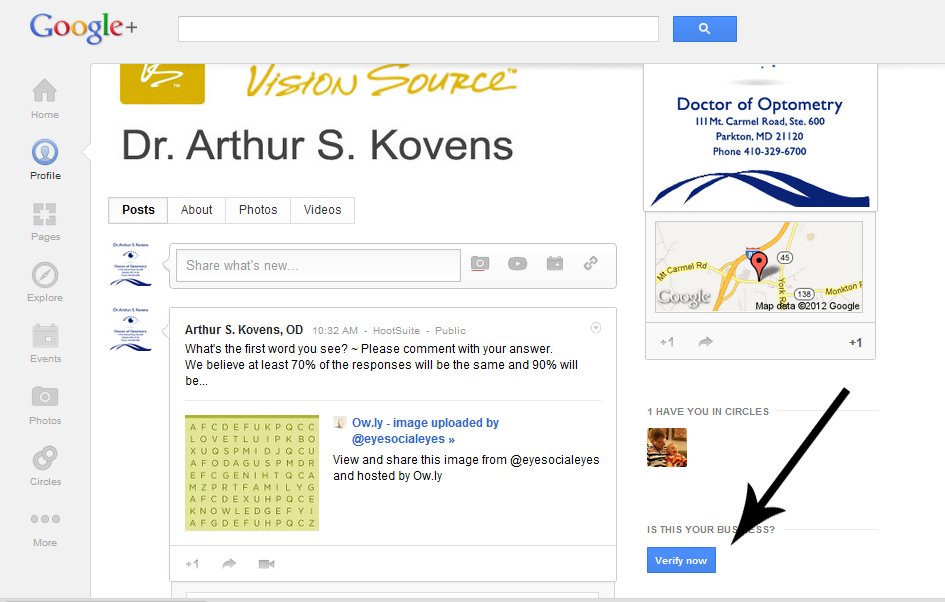
Steps to verify your Google+ Page.


Have you verified your Google+ Page yet? By verifying your Google+ Page it allows you to connect it to your Google+ Local Page. As you can see here http://bit.ly/VeoBh7 my Google+ Local listing (The one where people write reviews) is now connected to my Google+ Page (Think of it as Facebook for Google). You can see my posts and review me as well.

Go to your Google+ Page and follow the easy steps below!
 
1. Click "Verify".


2. Choose your Google+ Local listing and Click "Yes Let's Continue"


3. Click "Yes Let's Continue".


4. Click "OK" They will send a postcard with a Pin Number to your Office.


5. Once you receive the Pin Number go to your Google+ Page, click "Enter Pin" and Enter your Pin.


6. Voila! You are now Verified!

Wednesday, September 19, 2012

Optimize your Youtube Video for the Search Engines.

We often forget that YouTube is the second largest search engine in the world. Being a site that hosts videos, we tend to miss the fact that a lot of people also use YouTube as a search engine to find what they want and need. These are the people who like to consume content in the form of video and are usually more qualified buyers and subscribers than the visitors from search engines.
A few years back, if you posted a video on YouTube with the relevant keyword in the title, it would rank in the top 10 results easily. But nowadays there are so many videos being uploaded in YouTube that YouTube SEO has become as important as website SEO. As an added bonus, one can optimize their YouTube videos and move their rankings up in YouTube search result pages just like in Google search results.
Many marketers have talked about YouTube SEO so I will start with the most elusive concepts first and then I will cover the frequently talked about tips as well.

1. Closed Captions

While watching YouTube videos you would have noticed a button ‘CC’ in the bottom right corner. CC stands for closed captions. YouTube is becoming global now and videos created in India are being watched and shared by people in US; videos from Europe are reaching people in Sri Lanka and so on. Captions not only enable more people to consume your video but YouTube also crawls the content in the captions! This has been proved by many experiments where we include a unique text string inside the captions file and when that string is searched on Google or YouTube the video will come up!
Earlier it used to be a complicated process to add CC to a video – one would need to specify the start and end time of each line and it would take hours. But recently YouTube introduced a speech recognition technology/feature which automatically detects the start and end of each line spoken and matches it to the video’s audio. So all you need to do is upload the script of the video and the captions will appear exactly in sync with the video. It is amazing how YouTube does this – but it is also the reason they are the No.1 in this market.
So a video on a topic with CC should definitely outrank the video on the same topic with no CC provided other SEO factors have also been taken care of.

2. Adding the Script in the Description

If you are creating the script for the speech in video, then adding the same script in the description of the video shouldn’t take much time. Google indexes this as well.

3. Naming the Video File with Keywords

If you are uploading a video about the ‘Health Benefits of Organic Foods’ then the file name of the video should be something like organic-food-benefits.avi or something similar. MOV0234.AVI is not going to be meaningful. The viewer of the video does not look at this but YouTube gives a relevancy credit to the file name because if your file name is named with your keyword then there is a better chance that your video is about what it says.

4. Create a More Engaging Video

This probably sounds straight forward and simple and you may even be tempted to skip this paragrapgh – BUT WAIT. I am about to say something which will blow you away.
YouTube gives relevancy credits to videos where people watch it for a longer time. This is not just a theory but has been tested by us. We uploaded two videos with almost the same SEO factors built in but the only change was the perception by the real human visitor. One video was engaging and the other video was not engaging to the real humans. 6 months later the more engaging video was ranking much better than the other video. So yes, YouTube gives credit to videos which are more engaging because it is a good way to measure the quality of the video.
For the purposes of guarding my niche from competition, I cannot reveal the videos I tested – so if you have a hard time trusting me, you can ignore this fact at your own risk.

5. Authoritative YouTube Channel

If you are posting a video on a fresh YouTube channel it is not going to have as much SEO power as the same video uploaded on a channel with has a lot of other good videos on the same topic. This is similar to website SEO – Posting an article in a fresh blog vs. posting an article in a high PR established blog makes a difference between heaven and hell.
Not only the video would get better rankings, but it will grow faster when the subscribers of that YouTube channel like, comment and share that video.
So always try to have established youtube channels for each of your niche and avoid posting videos on fresh channels. Also avoid posting irrelevant videos in the channels – it may dilute the SEO power of all the other videos on that channel.

6. Posting HD Videos Instead of SD

It is astonishing how many marketers do not even mention about uploading HD videos. Again this has been tested by us in several occasions. HD videos out-rank standard definition videos every time.
You may think that YouTube may not prefer HD videos because it costs them a lot of storage space and bandwidth – but they have more resources that you can imagine. The reason why they limit the length of the videos is not because of lack of storage or bandwidth but to prevent people from uploading copyrighted videos. This has been confirmed by YouTube itself.
It makes sense that a HD video should be better than a standard video. If someone is investing the energy and resources in creating a HD video then the content could be equally good.
So try to upload 1080P videos whenever possible and if you are doing screen cast or presentation videos – 720P should do the job.
Some of the other commonly talked about SEO methods are
  • Having a relevant headline with proper keywords
  • Putting your link in the description above other content with http://
  • Including tags from other videos which rank well for the keywords that you are targeting
  • Giving a call to action at the end of the video for liking your video and/or subscribing to your channel.
Hope you found my insights useful. Please leave you comments.

Wednesday, December 14, 2011

Social Media tips fo the Eye Care Professional, Internet Marketing for the Vision Care Community.


It’s a fair bet that your boss, dates and anyone you give your business card to will type your name into a search engine. If something negative appears in the results, your online reputation can quickly damage your offline reputation — and affect your life.
Of the almost 80% of U.S. hiring managers who had searched for candidates online, 70% of them said they had rejected a candidate based on what they found in his or her search results, according to a 2009 study commissioned by Microsoft.
While you might not be able to remove damaging content from the Internet, there’s a good chance that you can minimize its impact using simple SEO techniques. And even if your search results are squeaky clean, the same techniques can help you control how you’re perceived online.
Here’s how to get started.

Step 1: See Where You Stand


Before you can manage your online reputation, you have to assess it. Type your names in search engines. Set up search alerts for your name (Google recently made this easier to do from the Google dashboard through a new “Me on the Web” tool).
If you find something unflattering, ask yourself:
  • Did I post it? If, for instance, photos from your Flickr account that you’d rather keep private are showing up in search results for your name, you can simply delete the photos or adjust your privacy settings.
    After you’ve removed the offensive content, you can use Google’s URL removal tool to stop it from appearing as a cached copy or snippet in search results. If you do nothing, the content will still eventually drop from Google’s index — it will just take a bit longer to disappear.
  • Is it personal information that could be used in a crime? If someone posts your social security number, bank account number, credit card number or an image of your handwritten signature, Google will makeefforts to remove it from search results. It will also contact the site’s hosting company to request that the page be taken down.
  • Is it posted on a high-traffic news site? Competing for search results with a popular news site is difficult. ButPatrick Ambron, the cofounder of a personal online reputation management service called Brand-Yourself, says that all hope is not lost. “Google usually only likes to rank one result per domain name per page,” he says. “So if you could get another result on the same domain name like Huffington Post that was better optimized for your name, you could theoretically knock the bad article off.” One way to do this is to create a profile on that news site using your full name. Use as many links as possible, and link to the profile from all of your other web properties.
If you can’t answer “yes” to either of these questions, your best bet for reducing the visibility of negative content is to compete for top search results using positive content.


If you can’t get the content removed from the original site, you probably won’t be able to completely remove it from Google’s search results, either,” reads Google’s guide to keeping personal information out of Google. “Instead, you can try to reduce its visibility in the search results by proactively publishing useful, positive information about yourself or your business.”
In other words, if you want to make negative webpages appear lower in search, you’ll need to create content of relevance to push the negative links down. Google suggests responding to negative reviews of your business, for instance.
Profiles on social networks are powerful tools for this purpose, as results from large sites like Facebook andTwitter often carry more SEO power than a single post on something like a personal blog.


Step 2: Post Positive Content


“If you can’t get the content removed from the original site, you probably won’t be able to completely remove it from Google’s search results, either,” reads Google’s guide to keeping personal information out of Google. “Instead, you can try to reduce its visibility in the search results by proactively publishing useful, positive information about yourself or your business.”
In other words, if you want to make negative webpages appear lower in search, you’ll need to create content of relevance to push the negative links down. Google suggests responding to negative reviews of your business, for instance.
Profiles on social networks are powerful tools for this purpose, as results from large sites like Facebook andTwitter often carry more SEO power than a single post on something like a personal blog.

Step 3. Create an Identity Hub

One secret to pushing your positive online presence further up in search results is to make a hub that links to all of your content. Ambron recommends these tips for pushing your hub to the top of search results for your name.
  • Claim your domain name. Including the search term (in this case, your name) in the URL of your web page tells search engines what the page is about.
  • Mention yourself. You’re trying to tell search spiders, “This page is about me!” A good way to do that is to use your name a lot. Use your name in tabs and headers.
  • Link to your content. “[Google] considers each link to your site a vote for the site,” Ambron says. “Google has gotten pretty smart, so where those links come from is very important. The more reputable links are better votes. A vote from CNN is better than some site you made that you just linked to yourself.”
    Remember all of those social media profiles that you created in step two? They’re attached to reputable sources like Facebook and Twitter, which makes their “votes” count as much more reputable than a page you just created.
    Sign up for as many of them as possible (use one of these sites to see what is available), and then link them all to your hub.
  • Post often. Search engines like fresh content. One easy way to create it is to post your social media feeds to your blog.
  • Step 4. Consider Automating the Process


    There are several services that will help you with your quest for a pristine online reputation for a small fee.Brand-Yourself, for instance, keeps track of your reputation on a dashboard and helps you improve it by helping you raise existing positive content or helping you create new positive content. Vizibility allows users to pre-select the information they want displayed in “search results” from a special button or URL that can be added to online profiles, websites, resumes, email signatures and business cards.

    This article was reposted form Mashable. http://mashable.com/2011/06/27/manage-online-reputation-seo/


      Series Supported by SES San Francisco Conference & Expo

      The Future of Search Series is supported by SES San Francisco Conference & Expo. Join more than 6,000 marketers August 15-19 at the Moscone Center for five days of education, inspiration and conversations with the most important voices online. Learn about the industry’s most pressing developments — everything from Google Panda to YouTube LIVE — and every essential topic, including email, display, mobile, search, social media, video and more. Register with “MASH20″ to save 20%. Join the discussion: #SESSF.

Tuesday, December 6, 2011

Getting over the Facebook hump! - Social Media Marketing - Optomerty, Vision Care, Eye Care

It's a great feeling when that facebook page you have been working on so hard on suddenly takes on a life of it's own. You've worked so hard setting up the apps, uploading the perfect pics, recruiting fans and blasting out posts and now people are starting to interact. Interaction is the key to a successful facebook page. Without it no one else reads your perfectly worded posts, no one sees your pretty pictures and worst of all no one shares your page with anyone else.

So how does one create a page that encourages social interaction? You can do it yourself if you have the time or you could hire a professional like SocialEyes. SocialEyes has been working with Eye Care Professionals for over 20 years now and they know how to create Social Media Gold! The Eye Care industry is a tough place to market yourself in but SocialEyes invented Social Media Marketing for the Vision Care Community!

We create an environment for your patients to interact in. Our Doctors now have hundreds of fans asking to buy contacts, find them special eye glass frames, leave them excellent reviews and comment on our interesting posts. These interactions create fans and these fans translate into happy patients who generate revenue.

Please stay tuned for more on getting over the facebook hump. It is late and I need my beauty rest :)

Thursday, November 24, 2011

What’s Next in Social Media Marketing? - It is time for Eye Care Professionals to ride the Bandwagon.

Here are the top 10 insights:

1) The physical and digital worlds will be more highly connected than ever before – already today we are able to run in the park and track our progress online while sharing it with our friends or track our weight loss, or even our ovulation (well, some of us, that is) with iPhone apps that connect to our Facebook and twitter profiles and enable us to keep track of our progress as well as share the data with our friends. Robert Scoble had a brilliant presentation on this topic at the last TNW Conference in Amsterdam. You can see it here.

2) Facebook, Twitter and other major social networks will become increasingly what Fred Wilson coins “Social Dashboards”. In essence, Facebook and Twitter are social channels on which other companies can grow and develop their own technologies and businesses. Both Facebook and Twitter have created economies far larger than many nations. Take for example, companies like Stocktwits, Tweetdeck and Zynga, (amongst others) that have gained huge profits “piggybacking” on these two platforms.

3) Until now, brands have been very concerned with bringing as many people as possible to their pages. Consumer brands can now finally reap the fruits and build social commerce stores where Facebook users (all 700 Million of them) can purchase products on their favorite social network without needing to go to any destination site. Facebook will become one of the major channels of future online shopping.

4) Companies like Google, Facebook and Amazon are currently collecting information about each any every one of us: Our likes and dislikes, our interests and disdains. Soon in an age of Web 3.0, an age of Semantic Web, we will no longer need to search for information on the Web as information will find us based on all this data which companies are collecting. The right information will be served to the right people at the right time, saving us all a lot of time, effort and energy.

5) Mobile technology will become more dominant and NFC technology will be developed further enabling it to offer us special promotions, coupons and tips based on our geographical location and the interest graph we discussed in insight #3.

6) Human Relationships will no longer be as physically dependent and we will befriend and hang out with people from all over the world and all walks of life, all ethnicities and all beliefs, creating a worldwide melting pot.

7) We will no longer be passive media consumers. Media will interact with us in dynamic ways on all platforms. Just like gamers playing WOW today, we will all become a part of a virtual world unknown to us yet where we will all be avatars in the game of life.

8 ) As the Web is overloaded with more information, the content that we are exposed to will become more and more customized to our needs as companies will large sums of money to companies like Facebook and Google, making sure that the information we are exposed to is highly targeted to our interests. Rather than experiencing information overload, we will actually experience the opposite effect.

9) Companies will understand better how to measure the ROI of social media and realize that social media is not about the number of people brands have in their communities but rather the amount of engagement that they see on their page and the overall online sentiment they faced this month as opposed to the last. See Gary Vaynerchuk’s response to how companies should measure the ROI of social media in the video link above.

10) Services will become increasingly crowdsourced. Whether it be the way that we get from point A to point B (Waze), the way that we find answers to our questions (Quora), the manner in which we test our Websites (uTest), the way that we get things done (Fiverr) or the way that we share information (Wikipedia).
All of these insights are of course complete speculations based on my years of experience in the world of social media and following of trends occurring all over the digital space. Do you agree with these speculations? Is anything missing? What do you think is coming up next in social media?

Ayelet Noff is the founder and CEO of Blonde 2.0 , a New Media PR agency helping brands create brand awareness and increase social engagement. Check out Ayelet's Blonde 2.0 blog and Twitter.

Tuesday, November 15, 2011

Why is Blogging so important to Search Engine Optimization? Social Media Optometry

How many times have you heard someone say, I just want that top search result on Google? For a business website, the top spot in the search engine returns can be a lead generating machine.

Think about it. Google is where most people go when they are researching. What if there was a way to get your company’s website on that coveted first page? Well there is…

One of the best ways to gain that top spot is by blogging. Incorporating a blog into a website can have a huge impact on the overall website’s search engine rankings.

A blog does two important things in terms of the search engines:

Adds naturally occurring, keyword-rich pages.
Increases the potential for incoming links from high-quality websites.
This article will reveal the why and how for improving your search engine rankings with blogs.

Playing the Numbers—Static vs. Dynamic Websites
The average small business website includes anywhere from 10-20 static web pages. These are the basic pages you see on most sites such as the home page, an “about us” page, product descriptions and even pages with contact information. Once created, these pages rarely change. In some cases, even small changes on these pages can be an expensive proposition that involves bringing in a web designer.

If the site is well-built with all the appropriate code and metadata, the search engines will index these 10-20 pages of content. If the site is highly optimized and focused on a limited number of keywords, the search engines may connect those 10-20 pages with the right keywords (the search engine terms used to find information). However, due to the inherent needs of a website, some pages aren’t indexed for the desired keywords (i.e., contact forms).

Best-case scenario, 10-20 pages are recognized by the search engines as possible returns for the targeted keywords.

The Impact of Blog Posts
Now let’s take our static website and add a blog. For the sake of this example, let’s say that there are five representatives in the company who have each agreed to write one blog post per week.

Here’s where our blog really starts to pay off. Each time a new blog post is added, a new page is indexed by the search engines. By the end of the first month, the website has doubled the number of pages originally indexed by the search engines.

Within a month, our website—which originally had 10-20 pages in the search engine pool—now has 30-40 pages that can possibly be returned in the top spot on Google. Stretch that out over the course of a year and our 10-20 page website now has around 250 pages indexed in the search engines.

And while a blog post a day is a lot of work, scale it back to one blog post per week and we’ve still more than doubled the number of indexed pages during the first year.

Each indexed page adds another ticket to the great Google lottery. The more tickets you hold, the better chance of winning the top spot in the search engine rankings.

The Power of Incoming Links
Now let’s say that our faithful bloggers have been adding their daily posts on topics of interest to their industry. Word gets around that they put up some valuable information and at the very least offer a voice for the company. A couple of blog posts have been emailed to fellow colleagues and even better, fellow industry bloggers are starting to link to the blog. The site starts to appear on fellow bloggers’ blog rolls and specific posts are linked as references and points of discussion in other online publications.

Google likes these incoming links. Google likes them even more when the links come from sites that are relevant to the content in the blog.

Then one day, a mild-mannered New York Times reporter is conducting research for a story related to our company’s industry. Because the blog has added a number of indexed pages to the website and others have started to link to the blog, it pops up in the reporter’s Google search. Our reporter includes a link to the blog in his article.

Google really likes incoming links from big, high-traffic sites like the New York Times. Along with the initial traffic sent to the blog from the New York Times article, Google sees that the New York Times linked to our site in an article related to keywords indexed in our blog. Google recognizes that the New York Times is an important Internet site and makes the connection that because the New York Times has linked to our little blog, our blog must be important. Thus Google moves it up the search engine rankings.

Congratulations. Thanks to the addition of a blog, our little website of 10-20 static pages now holds one of the top spots in Google search results.

Indexed Pages + Relevant and Reputable Links = Search Engine Success
At the 2009 WordCamp San Francisco (a gathering of WordPress users), Google’s Matt Cutts pointed out the importance of being both relevant and reputable. Incoming links from reputable sites such as the New York Times in which the content is relevant to the content in the post are highly valued by Google.

A blog is one of the best ways to continually add pages to a website that generate relevant and reputable links.

In the scenario above, our business blog has managed to provide both relevant content and generate reputable links—two big keys to success on Google.

Real-World Example
Don’t believe me? Let’s take a look at a real-world Google search to see the impact of a blog in action.

Let’s say that we’ve just moved to Baltimore and need a realtor to help us find a new home. We go to Google and search “Realtor Baltimore.” Once we get past the map-based search results (important to note), the national sites such as Realtor.com and the national brokerages, one of the first local real estate agents to show up in the organic search results is Wayne Curtis at www.charmcityrealestate.com.

CharmCityRealEstate.com includes a blog with posts dating back to November 2006. As you can see in the image below, Google has indexed 145 pages of CharmCityRealEstate.com. Many of these pages are blog posts filled with naturally occurring keywords related to the real estate market in Baltimore.


Now let’s take a look at another realtor in the Baltimore area. This realtor’s website did not rank in the Google search results and does not include a blog. As you can see from the image below, the site shows only 14 pages indexed with Google.


Measuring incoming links is a little more difficult as different tools return different numbers. You can get a basic overview by using the search term “link:yourdomain.com” in both Google and Yahoo. Using Alexa.com’s “Site Info” tool we can see www.charmcityrealestate.com’s top incoming links. The very first link returned on Alexa is a link from HDTV.com’s television series House Hunters, a highly relevant and reputable real estate site.


Quality of Pages Indexed and Incoming Links
When conducting this experiment, you can find sites that don’t rank as well on Google yet have more pages indexed. This is often because the pages indexed do not rank for the keywords searched. A topical blog naturally lends itself to keyword-rich posts just by the nature of the content.

The same holds true with incoming links. Too many incoming links from websites that are not relevant to the content on the site can actually hurt a website’s search engine ranking.

Consider Keywords When Creating Posts
Now that you can see the importance of keyword-indexed blog posts, you can begin to optimize your posts to include relevant keywords.

Going back to our example above, we can use the Google Keyword Tool to see that during the month of March, the phrase “Realtor Baltimore” was searched on Google 2,900 times in the U.S.; however, the phrase “Realtors Baltimore” was searched 60,500.


Since “Realtors Baltimore” was searched around 57,000 more times than “Realtor Baltimore,” it would be wise to use both terms when writing a post about choosing a realtor in Baltimore.

Incorporate the Blog
If the goal is to raise the search engine results of the larger website, it is important to incorporate the blog into the larger website. Use a call to action at the end of the blog post to direct the reader to other parts of your website. Keep it on the same domain and provide clear links that encourage visitors to explore the rest of your website.

Make it easy for your reader. If the path to your larger website isn’t clearly marked, they will never find their way.

ROI
Measuring the ROI of social media is tricky, but consider the value of the top spot on Google. How much would you pay for the top organic search return? Although it doesn’t happen overnight, a blog can be one of the best ways to get there.

Have you seen a jump in the search engine rankings since adding a blog? If your business is not blogging, what’s holding you back?

By Jim Lodico
Published May 24, 2010

Recent Posts